Modeling Underactuated Swimmers in Granular Fluid Using Geometric Mechanics
IEEE International Conference on Robotics and Automation (ICRA) -- May 2025
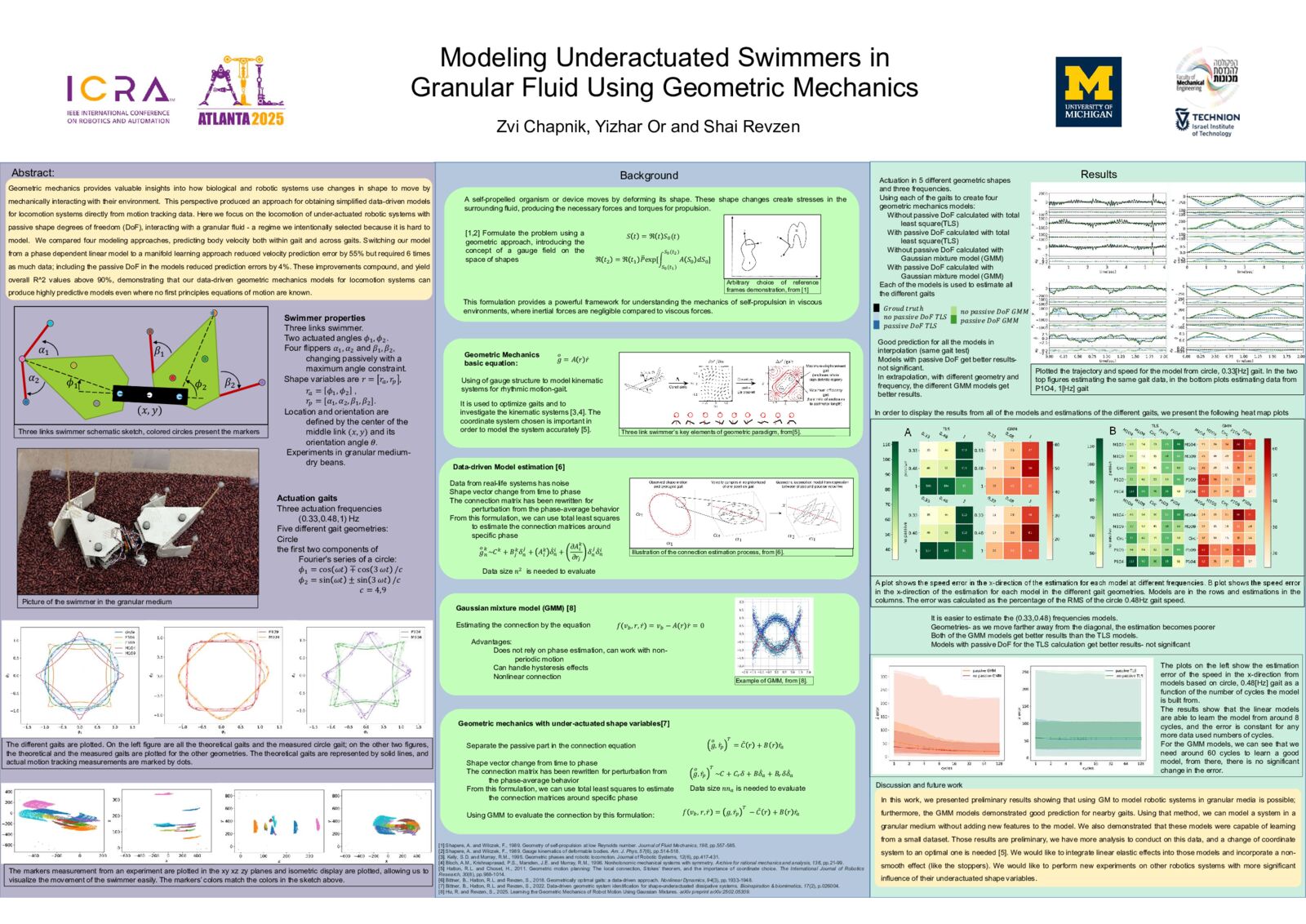
Geometric mechanics provides valuable insights into how biological and robotic systems use changes in shape to move by mechanically interacting with their environment. This perspective produced an approach for obtaining simplified data-driven models for locomotion systems directly from motion tracking data. Here we focus on the locomotion of under-actuated robotic systems with passive shape degrees of freedom (DoF), interacting with a granular fluid - a regime we intentionally selected because it is hard to model. We compared four modeling approaches, predicting body velocity both within gait and across gaits. Switching our model from a phase dependent linear model to a manifold learning approach reduced velocity prediction error by 55% but required 6 times as much data; including the passive DoF in the models reduced prediction errors by 4%. These improvements compound, and yield overall R^2 values above 90%, demonstrating that our data-driven geometric mechanics models for locomotion systems can produce highly predictive models even where no first principles equations of motion are known.