Walking on Rough Terrain with Any Number of Legs
Design Expo -- Winter 2026
 MuRoAM team
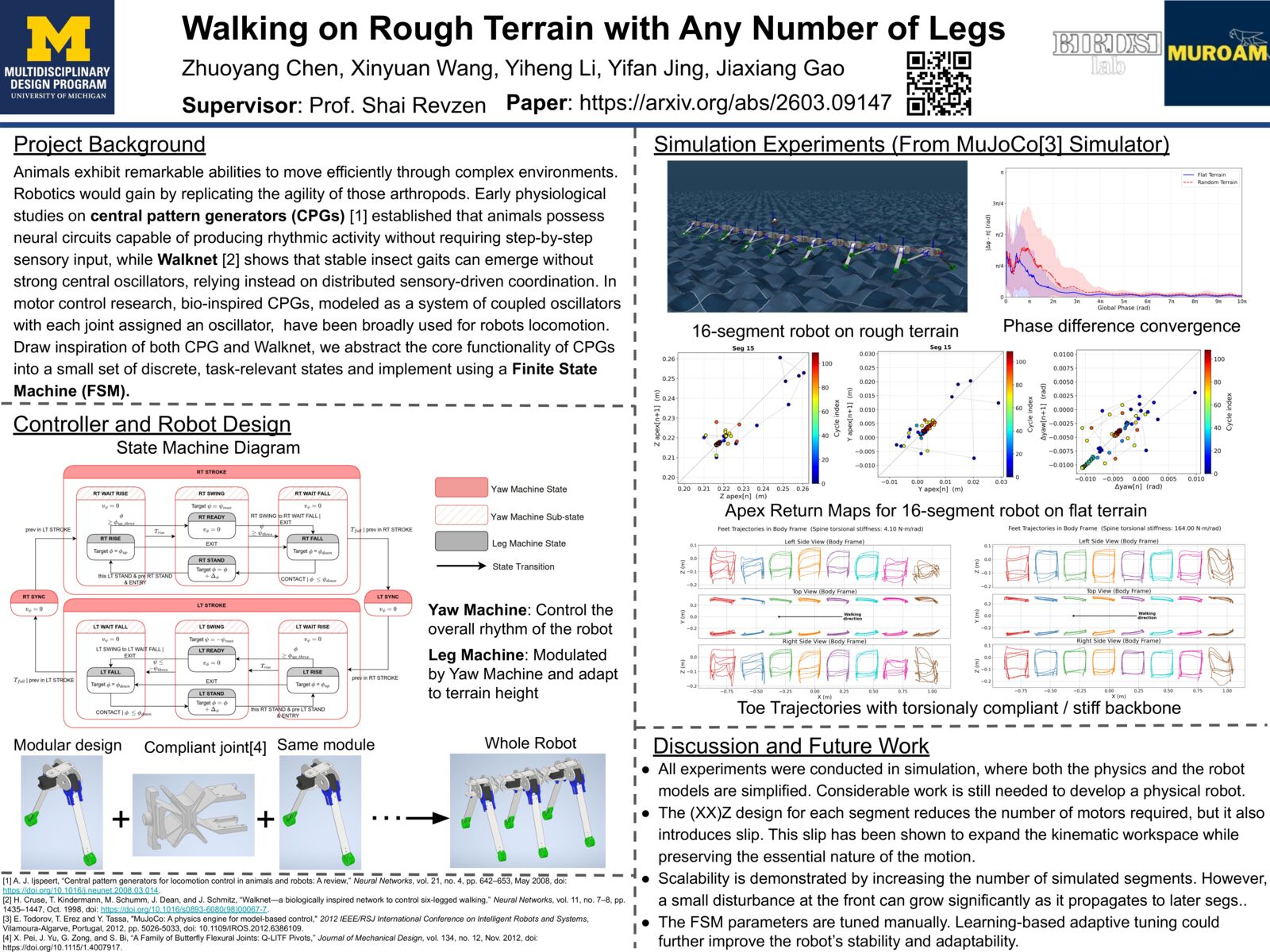
Animals exhibit remarkable abilities to move efficiently through complex environments. Robotics would gain by replicating the agility of those arthropods. Early physiological studies on central pattern generators (CPGs) [1] established that animals possess neural circuits capable of producing rhythmic activity without requiring step-by-step sensory input, while Walknet [2] shows that stable insect gaits can emerge without strong central oscillators, relying instead on distributed sensory-driven coordination. In motor control research, bio-inspired CPGs, modeled as a system of coupled oscillators with each joint assigned an oscillator, have been broadly used for robots locomotion. Draw inspiration of both CPG and Walknet, we abstract the core functionality of CPGs into a small set of discrete, task-relevant states and implement using a Finite State Machine (FSM).